Smart Locks vs. Traditional Locks: Pros and Cons for Home, Apartment and Building Owners
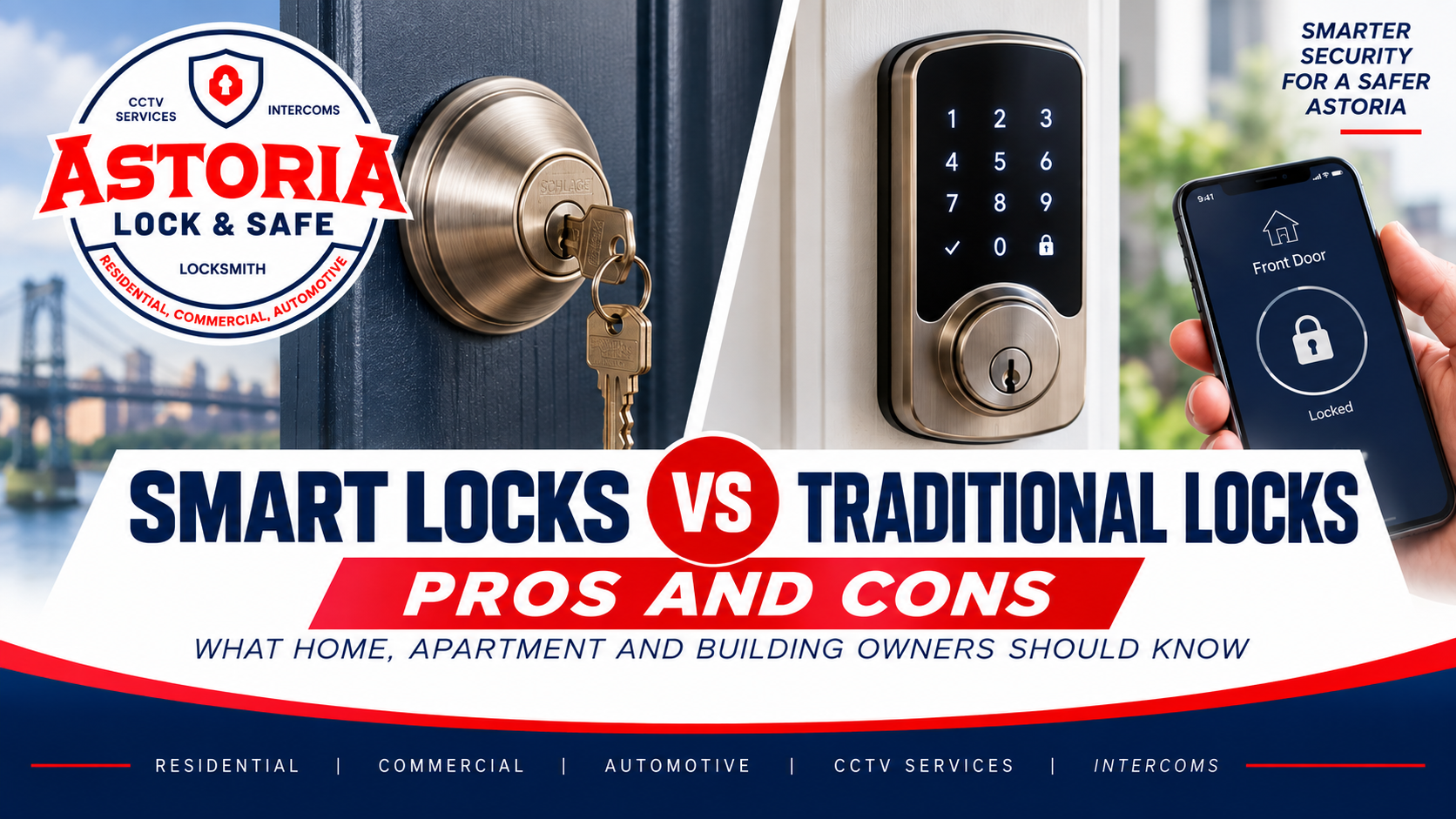
Locks have changed considerably over the past decade. For generations, securing a home, apartment, office, or commercial building was relatively straightforward: install a quality deadbolt, keep track of the keys, and replace or rekey the lock when security needs changed. Today, property owners have another major option—smart locks.
Smart locks can allow doors to be opened with a smartphone, keypad, fingerprint, electronic credential, or even remotely through an internet connection. Some can generate temporary access codes, maintain access histories, integrate with alarm systems, and become part of a larger smart-home or building-security system.
These capabilities are useful, but they also create a common misconception: a smart lock is not automatically a more secure lock.
The most important question is not simply whether a lock is “smart” or “traditional.” The better question is: Which locking system provides the right combination of physical security, reliability, convenience, access control, and emergency operation for this particular door and property?
For homeowners, apartment owners, landlords, property managers, and commercial building owners, understanding that distinction can prevent an expensive—and potentially dangerous—mistake.
What Is the Difference Between a Smart Lock and a Traditional Lock?
A traditional lock is a mechanical locking device that generally uses a physical key to operate the lock cylinder and locking mechanism. Residential deadbolts, knob locks, lever locks, mortise locks, and many commercial locking systems fall into this category.
A smart lock incorporates electronic technology into the locking or access-control process. Depending on the model, the lock may be operated using a PIN code, smartphone application, fingerprint, electronic credential, Bluetooth connection, Wi-Fi connection, or another digital method.
Some smart locks replace the entire existing lock. Others attach to or operate an existing deadbolt.
This distinction matters because the electronics and the physical lock are two different parts of the security equation. An electronic system may have excellent software features while being attached to an ordinary physical locking mechanism. Conversely, a traditional high-security mechanical lock may offer exceptional resistance to physical attack without providing any electronic conveniences.
For that reason, evaluating a lock requires looking beyond the technology used to unlock it.
Advantages of Smart Locks
1. Smart Locks Can Eliminate Much of the Hassle Associated With Keys
Convenience is probably the biggest advantage of a smart lock.
With a keypad-equipped lock, for example, an authorized person can enter a code instead of carrying a physical key. Depending on the system, residents may also unlock the door through a smartphone or another electronic credential.
This can be particularly useful for families, landlords, offices, contractors, maintenance personnel, cleaning services, and buildings in which several people require access.
There is no need to make numerous duplicate keys simply because several people need to enter the property.
2. Temporary Access Can Be Much Easier
One of the best applications for smart-lock technology is temporary access.
Suppose a contractor needs to enter an apartment between 10:00 a.m. and 2:00 p.m. Instead of handing that contractor a physical key—which could potentially be copied—a compatible smart-lock system may allow the owner or manager to issue a temporary access code.
Once the authorized period ends, the code can be disabled.
For landlords and building managers, this capability can dramatically simplify access management.
3. Some Smart Locks Provide Access Records
Certain smart locks and electronic access systems maintain records showing when the lock was operated and, depending on the system, which credential was used.
This can be useful in rental properties, offices, multifamily buildings, and other locations where owners need better control over who enters the premises.
However, owners should understand exactly what information their particular system records. Capabilities vary significantly among manufacturers and models.
4. Lost Credentials May Be Easier to Manage
When someone loses a traditional key, the property owner has to consider an uncomfortable question:
Who might now have that key?
If the answer is unknown, rekeying or replacing the lock may be appropriate.
With many electronic systems, a lost credential or compromised code can simply be deleted or changed without physically altering the lock cylinder.
This is one reason electronic access control has become attractive to property managers.
5. Remote Lock Management May Be Possible
Internet-connected smart locks may allow owners to check lock status or control access remotely.
Imagine leaving home and wondering whether you locked the front door. A compatible smart-lock system may allow you to check its status through an application.
Some systems can also send notifications when a door is unlocked.
For people managing more than one property, these capabilities can be especially useful.
6. Smart Locks Can Integrate With Other Security Technology
Depending on the manufacturer and system, smart locks may work with alarms, video doorbells, surveillance systems, intercoms, home-automation platforms, and other security technology.
A properly designed system can therefore make the lock one component of a larger security strategy rather than an isolated device.
Disadvantages of Smart Locks
The convenience is real, but smart locks introduce considerations that do not exist—or exist to a much lesser degree—with purely mechanical locks.
1. Smart Locks Require Power
Traditional mechanical locks do not need batteries.
Electronic locks do.
Most residential smart locks are battery powered, and eventually those batteries need replacement. Many systems provide low-battery warnings, but warnings only help when someone notices and responds to them.
Owners should know what happens when the battery becomes completely depleted.
Does the lock have a physical key override? Does it have external emergency power contacts? Is there another means of entering the building?
These questions should be answered before the lock is installed.
2. Electronics Add Additional Failure Points
A traditional mechanical lock is relatively simple. A smart lock may contain a motor, circuit board, wireless communication hardware, sensors, batteries, software, and mechanical components.
Every additional component introduces another potential point of failure.
That does not mean smart locks are unreliable. Quality smart locks can perform very well. It does mean owners should avoid choosing a lock solely because it has the longest list of technological features.
Reliability should remain a primary consideration.
3. Connectivity Can Create Problems
Some smart-lock functions depend on Bluetooth, Wi-Fi, a hub, a smartphone, an internet connection, or a manufacturer’s cloud service.
Ask what happens when one of those components is unavailable.
If the internet goes down, can the door still be unlocked locally?
If the phone battery dies, is there another way inside?
If Wi-Fi fails, does the keypad continue operating?
If a manufacturer’s online service becomes unavailable, which functions still work?
A well-designed security system should have sensible fallback options.
4. Cybersecurity and Privacy Become Part of Physical Security
Traditional locks have physical security vulnerabilities. Connected smart locks can have both physical and digital considerations.
Owners should favor established manufacturers that provide ongoing software or firmware support, strong authentication options, encryption, and clear security policies.
Passwords associated with smart-lock accounts should be unique and strong. Multifactor authentication should be enabled when available.
The property owner should also understand what information is stored remotely and who has access to it.
5. Not Every Smart Lock Is Physically Strong
This may be the most important point in the entire smart-lock discussion.
A beautiful smartphone application does not make a weak deadbolt strong.
The lock still has to physically prevent the door from opening.
The quality of the bolt, cylinder, strike, mounting hardware, door, door frame, and installation remains critically important.
When evaluating a smart lock, do not only ask:
“What can the app do?”
Also ask:
“How good is the lock?”
A knowledgeable Astoria Locksmith should evaluate the entire door-security system rather than focusing solely on electronic features.
Advantages of Traditional Locks
Traditional mechanical locks remain widely used for good reasons.
1. Mechanical Locks Are Simple
A well-made mechanical lock does one fundamental job: it mechanically secures the door.
There are no batteries to replace, no smartphone applications to update, no wireless connections to troubleshoot, and no online accounts to maintain.
For many homeowners, simplicity is a security advantage.
2. Quality Traditional Locks Can Be Extremely Durable
A good mechanical deadbolt that is properly installed can provide many years of dependable service.
High-quality locks can also offer improved resistance to common forms of manipulation and physical attack.
The important phrase, however, is properly installed.
Even an excellent lock performs poorly when installed in a weak door or attached to a poorly reinforced frame.
3. Traditional Locks Continue Working During Power and Internet Outages
A mechanical lock does not care whether the electricity is on.
It does not care whether Wi-Fi is working.
It does not care whether a manufacturer’s server is operational.
For people who prioritize simplicity and independence from technology, this remains a significant advantage.
4. Traditional Locks Are Often Easier to Repair or Rekey
Many conventional locks can be serviced or rekeyed without replacing the entire lock.
If a tenant moves out, a key is lost, or access needs to change, a Locksmith in Astoria may be able to rekey compatible locks so the old keys no longer operate them.
This can be more economical than replacing all of the hardware.
Disadvantages of Traditional Locks
Mechanical locks also have limitations.
1. Physical Keys Can Be Lost
Keys disappear. They are left in taxis, dropped on sidewalks, misplaced at work, and forgotten in restaurants.
When a key disappears, owners have to decide whether the circumstances justify rekeying the lock.
2. Keys Can Be Duplicated
Ordinary keys may be relatively easy to copy.
If uncontrolled key duplication is a concern, owners should discuss restricted or higher-security key systems with a qualified locksmith.
This can be particularly important for landlords and businesses where keys may pass through the hands of employees, tenants, contractors, or vendors.
3. Traditional Locks Provide Little Information About Who Entered
A mechanical lock normally cannot tell the owner whether someone entered at 9:00 a.m. or 9:00 p.m.
Nor does it identify which authorized key was used.
Electronic access-control systems can provide much more sophisticated management capabilities when those capabilities are needed.
Smart Lock vs. Traditional Lock: Which Is More Secure?
There is no universal answer.
A high-quality traditional deadbolt can be more secure than a poorly constructed smart lock, while a well-designed smart lock with strong physical hardware can provide excellent security plus additional access-control capabilities.
The correct comparison should therefore consider several factors:
- Quality of the physical locking mechanism
- Strength of the door and frame
- Strike-plate installation
- Resistance to forced entry
- Quality of the lock cylinder
- Reliability
- Availability of emergency access
- Electronic security, when applicable
- Access-control requirements
- Professional installation
In practice, the door and frame can be just as important as the lock.
A heavy-duty deadbolt attached to a damaged or poorly reinforced frame may provide less protection than the owner expects.
What Should Apartment Owners and Landlords Consider?
Landlords have different requirements from many single-family homeowners.
Access has to be managed across tenants, employees, contractors, superintendents, maintenance personnel, and sometimes emergency personnel.
Electronic access can simplify these relationships considerably.
For example, a landlord may be able to issue separate credentials rather than distributing physical keys. When authorization ends, the electronic credential can be disabled.
However, landlords should also consider applicable building requirements, fire and life-safety rules, lease obligations, emergency access, and the practical realities of tenants using the system every day.
The newest technology is not necessarily the best technology for every building.
Reliability matters enormously in multifamily housing.
Are Smart Locks Good for Commercial Buildings?
Smart locks can be excellent for certain commercial applications, but larger commercial properties may require something more sophisticated than a consumer-grade residential smart lock.
Businesses may benefit from commercial access-control systems that allow individual credentials to be created, modified, tracked, and revoked.
A business owner may want to know:
Who can enter?
Which doors can they enter?
During what hours?
Can access be immediately revoked?
Is there an audit trail?
How does the system function during a power failure?
These are access-control questions, not simply lock questions.
The appropriate solution may include commercial locks, electric strikes, magnetic locks, card readers, keypads, intercom systems, door closers, panic hardware, surveillance equipment, or other components depending on the building and applicable requirements.
Can a Smart Lock Be Installed on an Existing Door?
Often, yes, but compatibility must be evaluated.
Some smart locks replace an existing deadbolt. Others operate the existing deadbolt from the interior side.
Before installation, the door should be checked for alignment and proper operation.
This is especially important with motorized locks.
If someone currently has to push, pull, or lift the door while turning the key, installing a motorized smart lock without correcting the underlying alignment problem can create trouble.
The motor is being asked to overcome resistance that should not be present.
Correct the door problem first.
What Happens if a Smart Lock Battery Dies?
The answer depends on the lock.
Some models provide a conventional key override. Others offer an external emergency-power method or another backup procedure.
Owners should learn the emergency procedure immediately after installation—not when they are locked outside at midnight.
If a lock fails unexpectedly and there is no usable backup entry method, an Emergency Locksmith in Astoria may be needed to gain entry and diagnose the problem.
This is also why homeowners should not ignore low-battery notifications.
Do Smart Locks Work Without Wi-Fi?
Many can perform basic locking and unlocking functions without an active internet connection, but the exact answer depends on the model and how it is configured.
Remote access, notifications, integrations, and other cloud-connected features may stop working when internet service is unavailable.
Before purchasing a lock, determine which features work locally and which depend on internet connectivity.
Can Smart Locks Be Picked?
A smart lock containing a conventional key cylinder may potentially be vulnerable to some of the same physical attacks that apply to other locks, depending on the cylinder and its design.
Electronic operation does not eliminate physical security concerns.
Likewise, eliminating the visible keyway does not automatically make a lock impervious to attack.
Security should be evaluated as a complete system rather than by one feature.
Is a Keypad Lock the Same as a Smart Lock?
Not necessarily.
Some electronic keypad locks operate locally without Wi-Fi, cloud connectivity, or a smartphone application.
For some property owners, this middle ground is ideal.
A keypad can provide keyless convenience without requiring a fully internet-connected lock.
This can be particularly attractive for owners who want to eliminate routine key use but prefer a relatively simple electronic system.
Should You Keep a Physical Key Backup?
Where the lock supports it, having a secure backup method can be valuable.
However, the physical key should itself be properly controlled.
Hiding a spare key under a mat, flowerpot, fake rock, or other obvious location can undermine the security benefits of an otherwise excellent lock.
Backup access should be planned rather than improvised.
The Often-Overlooked Issue: Your Door Frame
People spend hundreds of dollars upgrading locks while ignoring the structure holding the lock in place.
That is a mistake.
A secure entrance should be evaluated as a system consisting of the:
door + lock + bolt + strike + frame + hinges + installation.
If one component is substantially weaker than the others, it can become the point of failure.
Longer or appropriate fasteners, properly installed strike hardware, good door alignment, and suitable reinforcement can significantly affect the overall security of an entrance.
This is one reason professional evaluation can be valuable. The best solution may not be replacing the lock at all. The actual problem may be the door, frame, strike, alignment, cylinder, or installation.
When Should You Call a Locksmith Instead of Installing a Lock Yourself?
Many locks are marketed as do-it-yourself products, and some installations are straightforward. However, professional installation becomes more important when dealing with expensive doors, older doors, commercial hardware, mortise locks, unusual door preparation, multifamily buildings, door-alignment problems, or security upgrades.
Poor installation can defeat the purpose of purchasing better hardware.
A professional locksmith can also determine whether the lock being considered is appropriate for the door in the first place.
And when a lockout, broken key, failed lock, burglary damage, or malfunction occurs outside normal business hours, access to a 24 hour locksmith Astoria service can become important.
Smart Lock or Traditional Lock: Which Should You Choose?
For a homeowner who values simplicity, long-term reliability, and independence from electronics, a quality traditional deadbolt may remain an excellent choice.
For someone who regularly provides temporary access to relatives, contractors, cleaners, employees, or guests, a smart lock or keypad lock may provide substantial convenience.
Landlords and property managers may benefit from electronic credentials because access can potentially be changed without collecting or redistributing physical keys.
Businesses with numerous employees may need a more comprehensive access-control system rather than either a basic residential smart lock or an ordinary mechanical deadbolt.
There is also no requirement to choose one technology exclusively.
A property can use traditional high-security locks on certain entrances and electronic access on others. In some situations, a smart-access system can operate in conjunction with quality mechanical hardware.
The best security system is the one designed around how the property is actually used.
Frequently Asked Questions About Smart Locks and Traditional Locks
Are smart locks safer than traditional locks?
Not automatically. Security depends on the quality of the physical lock, door, frame, installation, electronic system, and access-management practices. A quality mechanical lock may outperform a low-quality smart lock.
Are traditional locks outdated?
No. High-quality mechanical locks remain an effective and widely used security solution. Smart technology adds convenience and access-management capabilities, but it does not make mechanical security obsolete.
What is the biggest advantage of a smart lock?
For most owners, the primary advantage is access management. Codes or electronic credentials can often be issued, changed, or revoked without distributing new physical keys.
What is the biggest disadvantage of a smart lock?
Smart locks introduce dependence on batteries and electronics and, for some features, connectivity and software. Owners therefore need reliable backup-access procedures.
What is the biggest advantage of a traditional lock?
Simplicity and reliability. A quality mechanical lock does not depend on batteries, internet service, applications, or cloud systems.
Should landlords use smart locks?
They can be useful for rental properties because electronic credentials may simplify access management, but landlords should consider building conditions, emergency access, applicable rules, reliability, and tenant needs before choosing a system.
Do smart locks require Wi-Fi?
Not all of them. Some operate through local keypads or Bluetooth. Internet access is generally required for certain remote-control, notification, and cloud-based features.
Can an existing deadbolt be converted into a smart lock?
Some products are designed to operate existing deadbolts, while others require replacing the existing hardware. Compatibility depends on the door and lock.
Should the cheapest smart lock be avoided?
Price alone does not determine quality, but security hardware should not be selected solely on price or electronic features. Physical construction, reliability, manufacturer support, emergency access, and compatibility with the door should all be considered.
What should I check before buying a smart lock?
Check the door and lock compatibility, physical security of the hardware, battery requirements, backup-entry method, offline operation, manufacturer support, account-security features, and whether professional installation is advisable.
A Practical Locksmith’s Checklist Before Changing Your Locks
Before deciding between a smart lock and traditional lock, evaluate the entrance itself.
Ask whether the door closes and latches smoothly without being pushed or pulled. Examine whether the frame and strike are secure. Determine who needs access and how frequently access permissions change. Decide whether remote access is actually necessary or merely an attractive feature you may never use.
Consider what will happen during a power, battery, internet, or smartphone failure. Think about who will administer electronic codes and remove old users. Determine whether you need an audit trail. Consider whether uncontrolled key duplication is currently a problem.
Finally, evaluate the consequences of failure.
For a secondary interior office, temporary inconvenience may be acceptable. For the only entrance to a residence or a critical commercial doorway, reliability and emergency access deserve much greater consideration.
Final Thoughts: Technology Should Improve Security, Not Complicate It
Smart locks offer genuine benefits. They can eliminate much of the inconvenience associated with keys, simplify temporary access, provide greater control over users, and integrate a door into a broader security system.
Traditional locks offer something equally valuable: simplicity.
A properly selected and professionally installed mechanical lock can provide years of dependable service without batteries, applications, internet connections, or software updates.
For many properties, the best answer is not “smart locks are better” or “traditional locks are better.”
The better principle is:
Choose the strongest, most reliable locking and access-control system appropriate for the door, the building, and the people who use it.
For homeowners, apartment owners, landlords, and commercial property managers in Astoria and the surrounding Queens area, Astoria Lock and Safe, a commercial locksmith in Astoria, can evaluate existing locks, doors, frames, and access requirements before recommending an upgrade. That evaluation is particularly valuable when deciding whether a traditional deadbolt, high-security mechanical lock, keypad lock, smart lock, or more comprehensive access-control system is appropriate.
Good security begins with the lock—but it does not end there.